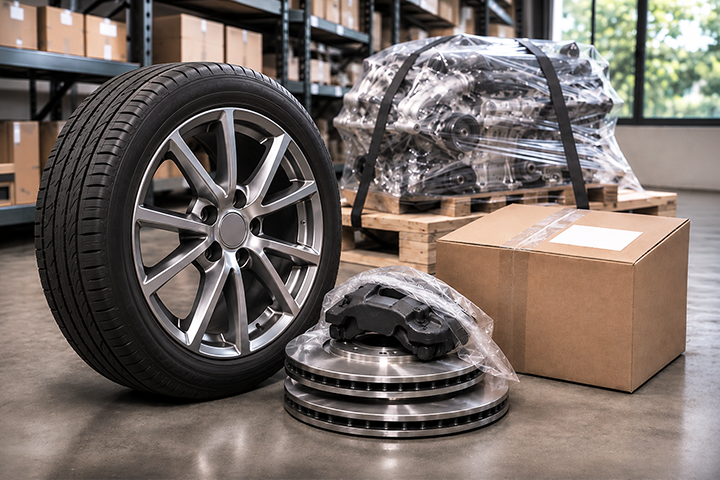
How to Ship Car Parts
A step by step guide to packing tires, rims, engines, transmissions and other auto parts, and insuring them in transit.
Auto parts are heavy, oddly shaped and often greasy or sharp, and some carry fluids that carriers won't accept. Drain what needs draining, pad every edge, and use a box or base built for the weight, then insure the shipment before it leaves your shop.
- Packing steps for tires, wheels and rims
- How to ship engines and transmissions, including fluids and freight
- How U-PIC insures auto parts shipments for less than carrier declared value
U-PIC has protected shipments since 1989 for parts dealers, salvage yards and online sellers.
Get Started with U-PIC
Complete this form and an agent will be in touch shortly
Parts Covered
New, used and rebuilt auto parts you sell are covered against loss, damage and theft in transit.
Significant Savings
Insure for 50 to 90% less than carrier declared value.
Paperless Claims
File online and get paid at invoice value once your claim is approved.
Parcel & Freight
Coverage for parcel shipments with UPS, FedEx and USPS, and for freight within your coverage limits.
How to Pack Auto Parts
- Clean and drain the part. Wipe off grease and oil, and drain any part that holds fluids. FedEx requires parts with lubricant or other fluids to be drained, or shown to be leakproof in every position.
- Pad every sharp edge. Cover sharp edges, corners and burrs with cardboard or foam. Bare metal edges can cut through the box, damage other packages and injure handlers.
- Bag it. Seal oily or dirty parts in a heavy plastic bag so residue can't soak through the box.
- Use a box built for the weight. Choose a double-wall box with room for cushioning, and brace the part with foam or cardboard so it can't shift. Bag small hardware and tape it inside the box.
- Seal and label it. Tape every seam, and put the shipping label on top of the box.
How to Ship Tires and Rims
- Tires on their own: tires don't need a box with FedEx. Clean them, and attach the label securely on the tread or a wrapped section.
- Rims and wheels: box chrome, painted or decorative wheels so they can't be scratched. Cover the face with cardboard, cushion the bottom of the box, set the wheel inside, and pad the sides and top before sealing.
- Wheels with tires mounted: pack them the same way as rims, with padding all around, so the wheel face is protected.
How to Ship an Engine or Transmission
- Drain every fluid. Drain oil, coolant and transmission fluid completely. For transmissions, FedEx says to drain all fluids, then pack the unit in a heavy-duty plastic bag with absorbent padding to catch anything left over.
- Remove all fuel. USPS accepts small engines only if they never held fuel or have been completely purged, with no fuel odor or residue, and gasoline is never mailable. Check your carrier's rules for anything that has held fuel.
- Secure it to a base. Bolt or strap the engine or transmission to a pallet or skid that a forklift and pallet jack can move, and cover open ports.
- Ship heavy parts as freight. With FedEx, shipments over 150 lbs. are freight, and an engine or transmission on a forkliftable base ships by FedEx air freight. Check your carrier's freight options before you build the crate.
Car batteries, airbags, fuel tanks and some fluids are hazardous materials. Get the manufacturer's safety data sheet and check with your carrier before shipping any of them. See FedEx automotive shipping.
How to Insure Auto Parts Shipments
Carrier declared value is liability coverage, not insurance. U-PIC insures the auto parts you sell, new, used or rebuilt, against loss, damage and theft in transit, at rates 50 to 90% less than typical carrier declared value. A claim is paid at the invoice value of the sale.
- Parts dealers, salvage yards and online sellers: insure every order through a U-PIC account. Get started and an agent will set it up with you.
- Single sales: insure one package with Buy Now, or several at once with Multi Buy.
U-PIC covers goods you sell, and claims are paid at the price on the invoice between you and your buyer, so parts you ship for your own use aren't covered. Coverage also excludes packages that are packed insufficiently or labeled with a description of the contents. Read the full terms on our coverage rules page.
If a Part Arrives Damaged
Ask the customer to photograph the box and the part before unpacking further, and to keep the part and all packaging until the claim is resolved. File your claim online within 90 days of the ship date. For domestic packages that never arrive, there is a 21-day waiting period before the claim is reviewed.
For the standard coverage this builds on, see our shipping insurance page, or browse coverage for other industries.
Get Started with U-PIC
Insure the auto parts you sell for less than carrier declared value.