How to Ship a Bike
A step by step guide to packing and shipping bikes and e-bikes to your customers, and insuring them in transit.
Bikes are big, oddly shaped and full of parts that bend: derailleurs, rotors, forks and wheels. Take the bike partly apart, protect every contact point, pack it tightly in a bike box, and insure the shipment before it leaves your shop.
- Packing steps for road, mountain and kids' bikes
- Battery rules for shipping e-bikes
- How U-PIC insures bike shipments for less than carrier declared value
U-PIC has protected shipments since 1989 for bike shops, brands and resellers.
Get Started with U-PIC
Complete this form and an agent will be in touch shortly
Bikes & Parts
New and used bikes, frames and components you sell are covered against loss, damage and theft in transit.
Significant Savings
Insure for 50 to 90% less than carrier declared value.
Paperless Claims
File online and get paid at invoice value once your claim is approved.
All Major Carriers
Coverage for shipments with UPS, FedEx and USPS.
How to Pack a Bike for Shipping
- Photograph the bike. Take photos of the frame, fork, wheels and drivetrain before you start. They show the condition the bike left in.
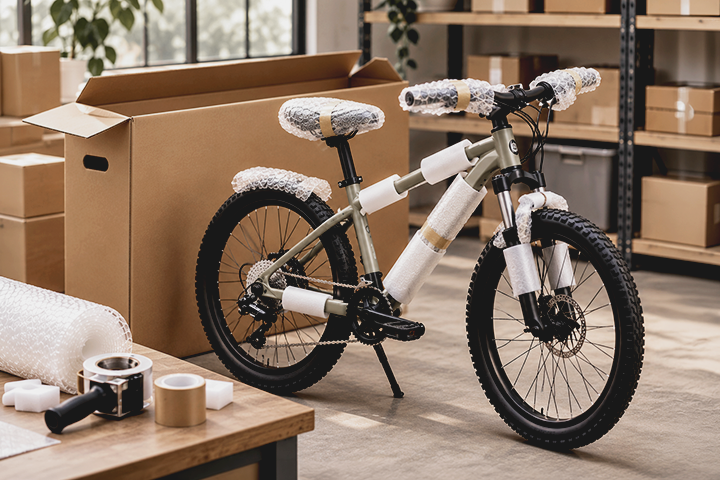
- Take it partly apart. Remove the pedals, front wheel and seat post, then loosen the handlebars and turn them parallel to the frame. On bikes with disc brakes, put a pad spacer between the brake pads so they can't close while the wheel is out.
- Protect the frame and fork. Wrap the frame tubes in foam tubing or bubble wrap, and fit plastic spacers in the fork and rear dropouts so they can't be crushed. Wrap the rear derailleur, or remove it and tape it to the inside of the frame.
- Secure every part. Zip tie the front wheel and handlebars to the frame so nothing can rub, and bag the pedals, skewers and small parts together, taped inside the box.
- Box it tightly. Use a sturdy bike box. If it's printed with the bike's brand or a picture of the bike, put it inside a plain box or cover the printing, since a box that shows what's inside counts as a descriptive label. Fill every gap with packing paper or foam until the bike can't shift, then tape every seam.
How to Ship an E-Bike
E-bikes run on large lithium-ion batteries, and carriers treat them as hazardous materials:
- USPS: under USPS Publication 52, mailable lithium-ion batteries can't exceed 100 watt-hours. Most e-bike batteries are well above that, so most e-bikes can't be shipped through USPS.
- UPS: ships e-bikes as battery-powered vehicles with hazardous materials markings, and won't accept them with damaged or defective batteries. See UPS battery shipping.
- FedEx: won't accept recalled or defective batteries, either on their own or in a product. See FedEx battery shipping.
Battery rules depend on the battery's size, whether it's installed or shipped separately, and the service. Talk to your carrier's hazardous materials team before you ship an e-bike or a spare e-bike battery.
Choosing a Carrier and Service
- Size and oversize charges: bike boxes are large, so UPS, FedEx and USPS may add oversize or dimensional weight charges. Check your carrier's size limits, and use the smallest bike box that fits.
- Tracking and signature: choose a service with tracking, and require a signature on delivery for high-end bikes so they aren't left on a doorstep.
- Plain labels: don't write a brand or model on the outside, and don't ship in a box printed with them. A label that describes the contents makes a package a target, and U-PIC coverage excludes packages with descriptive labels.
How to Insure a Bike Shipment
Carrier declared value is liability coverage, not insurance. U-PIC insures bikes, frames and components you sell, new or used, against loss, damage and theft in transit, at rates 50 to 90% less than typical carrier declared value. A claim is paid at the invoice value of the sale.
U-PIC covers goods you sell, and claims are paid at the price on the invoice between you and your buyer. A bike you ship for your own use, such as to a race or a new home, is a personal good and isn't covered. See personal goods for details.
Coverage also excludes packages that are packed insufficiently, so following the packing steps above protects both the bike and your claim. Read the full terms on our coverage rules page.
If a Bike Arrives Damaged
Ask the customer to photograph the box and the bike before unpacking further, and to keep the bike and all packing materials until the claim is resolved. File your claim online within 90 days of the ship date. For domestic packages that never arrive, there is a 21-day waiting period before the claim is reviewed.
For more on covering the gear you sell, see shipping insurance for sporting goods, or our shipping insurance page for the standard coverage this builds on.
Get Started with U-PIC
Insure the bikes you sell for less than carrier declared value.